

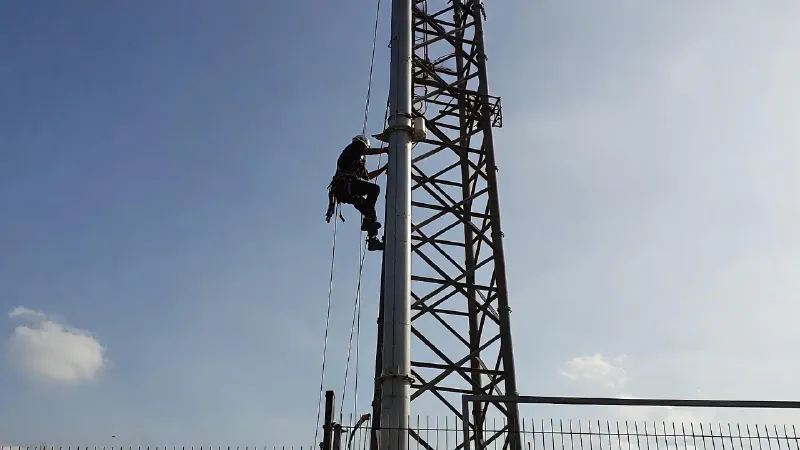
The rollout of 5G has fundamentally changed the design of wireless networks. Unlike earlier generations, 5G relies on a dense web of small cells and massive MIMO (Multiple Input Multiple Output) arrays to deliver ultra-low latency and gigabit speeds. This means that there is a very much increased dependency on the wireless backhaul.
For 5G to function at peak performance, the “wireless” network must be underpinned by a massive volume of “wired” infrastructure. However, as carriers rush to increase fiber counts, they are hitting a physical wall: duct congestion.
The Capacity vs. Space Conflict
When 4G technology was deployed, a standard loose-tube cable with 72 or 144 fibers (sometimes fewer) was often sufficient for a cell site. With 5G, front-haul and backhaul requirements are pushing those numbers much higher on each individual cable.
Using traditional loose-tube designs means that these higher fibre counts are unachievable within existing conduits. Using traditional ribbon designs means that these higher fibre counts are far too large to cost-effectively install into existing ducts. This leaves operators with a choice: undertake expensive new civil works or find a new way to pack more fibre into the same space while supporting the efficiency of the wireless workforce.
Scaling the 5G Backbone: SmartRIBBON and Mini Loose Tube
To solve the 5G density crisis, ScaleFibre has engineered two distinct pathways to maximize conduit capacity without compromising mechanical integrity: SmartRIBBON and Mini Loose Tube (MLT) technologies.
Mini Loose Tube: The High-Density Workhorse
For operators looking to optimise fibre counts (up to 864F), our Mini Loose Tube design is a great solution. This innovative design utilises reduced-diameter buffer tubes and advanced jacket materials, providing an industry-leading footprint compared with traditional outdoor cables.
This allows for more cables, or larger fiber counts, to be blown into existing microducts, effectively deferring the need for new civil trenching. The cable can also be pulled, making it a versatile option for field teams.
SmartRIBBON: The Ultra-High Density Evolution
When 5G densification demands massive fibre counts (864F to 3456F+), the time and labour cost to terminate those cables through splicing grows significantly. ScaleFibre SmartRIBBON technology provides a series of ultra-high fibre count designs with both low diameter and rapid termination.
Unlike traditional flat ribbons that are large, heavy, and rigid, SmartRIBBON uses an intermittently bonded matrix. This allows the 12-fiber ribbons to be rolled, bunched, or folded, which reduces the cable diameter and improves fibre routing. Despite its flexibility, the fibers remain organized in sets of 12, allowing for mass fusion splicing that is up to 75% faster than single-fiber splicing.
SmartRIBBON behaves like a loose-tube cable during installation, navigating tight bends and congested manholes with ease, but offers the density of a ribbon cable.
| Backhaul Metric | Mini Loose Tube (MLT) | SmartRIBBON |
|---|---|---|
| Ideal Fiber Count | 72F - 288F | 864F - 3456F+ |
| Splicing Method | Single Fiber Fusion | Mass Fusion (12 Fibers at once) |
| Duct Utilization | High (Micro-conduit optimized) | Ultra-High (Max density per in²) |
| Typical Application | Last-mile & Distribution | Critical Core & 5G Backhaul |
Reducing Burnout with Mass-Fusion Splicing
The transition to SmartRIBBON is driven as much by labor economics as it is by physical space. In high-count 5G deployments, the time required for fiber termination is a primary driver of Total Cost of Ownership (TCO). Splicing large fiber count cables as single fibers becomes very expensive, very quickly, and places a massive strain on the wireless workforce
Using mass fusion splicing on SmartRIBBON allows a technician to join 12 fibers in roughly the same time it takes to join one. While it takes approximately 12 hours to splice all fibers in a 432-fiber loose-tube cable, a 1,728-fiber SmartRIBBON cable can be completed in just over half that time. This represents four times the capacity in 40% less time. This advantage typically yields a massive reduction in labor hours, allowing field crews to activate ultra-high fiber count cables in days rather than weeks.
Solving the “Preferential Bend” Bottleneck
One of the most significant mechanical hurdles in high-density OSP (Outside Plant) environments is the rigidity of traditional ribbon fiber. Flat ribbons are more solid, only bending along one axis. This makes routing inside compact closures or housings nearly impossible for the wireless workforce tasked with site integration.
SmartRIBBON’s intermittently bonded matrix allows the ribbon to collapse into a round bundle, providing 360-degree flexibility similar to a loose-tube fiber. This eliminates the preferential bend and allows for a significantly smaller bend radius. Consequently, operators can use smaller, lower-cost closures and splice trays, even in the tight confines of street furniture or congested manholes.
Increasing Capacity Without Civil Works
Duct space is a finite and expensive resource. In many metropolitan areas, the cost to lay new conduit is prohibitive once permits and traffic management are factored in. The goal for modern rollouts is to maximize the “Fiber-to-Duct Ratio.”
SmartRIBBON effectively quadruples the capacity of existing infrastructure. For example, a standard 50mm (2") duct that would previously reach its physical pulling limit with 864 loose-tube fibers can now comfortably house a 3,456-fiber SmartRIBBON cable. This “density-first” approach gets the asset future-ready, ensuring the headroom for future AI-driven traffic and 6G densification is already in place without ever needing to apply for a new digging permit.
Conclusion
Building a sustainable 5G backbone requires a physical layer that balances extreme density with rapid deployment. By utilizing Mini Loose Tube for flexible distribution and SmartRIBBON for massive core backhaul—both reinforced by ScaleFibre’s high-strength engineering—operators can build a network that is durable and well designed. Through careful product selection, operates can ensure the wireless workforce is utilised with maximum efficiency.
Ready to Scale Your 5G Backhaul?
Get details for our Mini Loose Tube and high-density SmartRIBBON cables.
Get Technical SpecsWe'll help you find the right fiber density for your project.